Showing posts with label space stuff. Show all posts

Tuesday, May 28, 2019

... about that 2018 UN Climate Change report

All bad news, from just the last 2 years

All of the above headlines share one common thread: they are conditions directly caused by, or exacerbated by, climate change.  Perhaps you think it's just a "global" problem that doesn't  affect you, maybe only those living in Middle Eastern deserts or around the Arctic Circle.  But Jakarta also?  See, not even my kampung is spared.

... So this lead me to spend the weekend going through the 2018 IPCC report, which made a splash last October.  The full report is 400+ pages long and written in an esoteric format (because it is not original research; it's basically a summary of other people's existing primary research).  I skipped the lengthy PDF download (it's even longer than the Mueller report) and went straight to the "Summary for Policymakers", which is still 32 pages long, and read the charts first.  Still, it's amazing what we can learn by browsing a handful of diagrams -- especially for a layman with zero knowledge of environmental science.

So the "Global Warming of 1.5⁰C" by the Intergovernmental Panel on Climate Change is really a misnomer.  We are really on pace for something like 3-4⁰C of warming (against a baseline of year 1850 -- approx. the start of the industrial revolution, when we started using fossil fuels en masse).  The paper talks about 1.5 degrees, but it's an extremely optimistic scenario based on aggressive transformation of the global economy.  Nevertheless, the research is unequivocal that the warming is anthropogenic -- caused by human activity -- which is good because it means we can actually do something about it.

The direct impact of climate change is devastating:
  • Sea-level rise at least 10cm for every 0.5C rise of global temperatures, and ice sheet loss is irreversible over >100,000 years
  • Biodiversity and ecosystem loss on land and sea
  • Climate-related risks to health, food security, and water supply
Damages are estimated at US$54 trillion worldwide.

Avoiding the most serious damage requires massively transforming the world economy and energy usage within just a few years.  If you thought the Green New Deal was batshit crazy, then brace yourself:
  • Damages will be spread worldwide but unevenly. >50mn people in the US, Bangladesh, China, Egypt, India, Indonesia, Japan, Philippines and Vietnam will be exposed to coastal flooding
  • To prevent >1.5C of warming, the report said, greenhouse pollution must be reduced by 45% from 2010 levels by 2030, and 100% by 2050.
  • By 2050, use of coal as an electricity source would have to drop from nearly 40% today to between 1-7%.   Renewable energy such as wind and solar, which make up about 20% of the electricity mix today, would have to increase to as much as 67%.

Now let's go to the charts:


Since the industrial revolution, it took us some 140 years to pollute the earth and raise global temperatures by 0.5C; the next 0.5C took us just 30 years; and the next 0.5C is expected to take us <20 years, if not sooner.  It's clear that we've taken earthly resources for granted without much care of what's left behind.


The above shows that our civilization produces 40 Gigatons of carbon emissions every year, and that we need to reduce it *down to zero* in just 30 years to achieve our targets.  Can we just blame China and press them to, like, do something?  Let's turn to MIT Technology Review.


So, the answer is a resounding "No".  China's is the highest in the world, but even combined with USA, EU, and India, they amount to just 15% of annual greenhouse emissions.  This is a global problem in desperate need for a worldwide, coordinated solution.


The above shows the uneven distribution of temperature change: the poles bear the brunt.  For its part, Russia is fully embracing the problem by accelerating the creation of a new shipping route, while the US only wishes it could do the same //sad but true.   


So we need to fundamentally change how we generate energy.  Nuclear is a good source: very low carbon footprint, we just need to solve the cost issue and that pesky problem of long-term radioactive waste storage -- difficult yet shouldn't be intractable challenges.  Solar, wind and hydro are also possible, but they tend to be unreliable, depreciates rapidly within <20 years, and surprisingly, have (potentially large) carbon footprint and ecological impact.  The solution is likely a combination of several approaches, implemented in managed moderation.  Or maybe there's some new idea in the horizon, some technological innovation, but it's no excuse to postpone making good on environmental policy.  We can already see new developments that can help us better adapt to the changing world, like more resilient crop breeds, and satellite imaging to better prepare for wildfires..

---

Humanity has shown great ingenuity and staying power in resolving seemingly existential threats.  Remember the hole in the ozone layer caused by aerosols and CFC?  It's healing, and should be completely "cured" by 2030.

But if we've learned anything about American leadership on this greatest challenge of our lifetime, it has failed us.

Wednesday, April 24, 2019

What's with that black hole?


...So the interwebs went crazy last week with the first-ever photo of a black hole, and with the young computer whiz who was part of the team.  So what's the deal with the supermassive black holes, we've all seen pictures of them, right?

Concept art of an accretion ring and jet around a supermassive black hole. Although this has been our picture of how black hole engines ought to work for a long time, the Event Horizon Telescope has provided new evidence validating it. (NASA/JPL-CALTECH)

In case you didn't notice, everything we've seen have been artist illustrations (or Christopher Nolan's sci-fi) based on unproven theory, and this real-life picture shows that theory is, at the very least, on the right track.  But I'd say it's not really about black holes, it's a lot more profound.

We live in a depressing world plagued by wars, bigotry and xenophobia, criminality, and declining confidence over traditional institutions -- governments, culture, religions, and science.  So never take for granted the massive accomplishment -- something to be very proud of -- that we are able to link up 8 telescopes from Greenland all the way to Antartica, undertake coordination among 13 scientific institutions, and manage a global, multi-year effort towards one single goal.  That blurry orange blob is just the start -- not the end -- of a major scientific endeavor.


As with most scientific work, oftentimes we just don't know where things would lead to.  Viagra was discovered when chemists were working on heart disease drugs.  Alexander Fleming accidentally found mold as he was working with Staphiloccocus bacterium, leading to an antibiotic that has transformed modern medicine and saved millions of lives.

For the next 100 years, the single biggest challenge facing humanity is climate change.  We've already seen its adverse effects, especially on some of the most vulnerable societies like the Middle East/Africa and Latin America, but also wealthier parts of Europe (Brexit, anyone?) and the US (California wildfires, Colorado River drought, etc).  Many (most?) scientists believe climate change is anthropogenic, which is actually encouraging, because it means we can do something about it.  Astronomy as a science is highly relevant in this effort, because as we see more unprecedented extreme weather events, we can look for examples out beyond our home planet.  Climatologists have studied Venus, seeing what earth may look like when impacted by runaway greenhouse effect.  When we study Jupiter and Saturn, we can see gigantic permanent storms larger than the earth's diameter.


So we may not know where studying black holes will lead us.  But we're only scratching the surface now, and chances are, we will need that knowledge for our long-term survival.

Black hole "Gargantua" from Interstellar (2014)

Thursday, January 11, 2018

How NOT to write an astronomy article

Oh dear....

Linked article here.  Beware of "has Uranus been probed" jokes.

Friday, September 29, 2017

Earth had life very early

Disko Bay in Greenland

New research found Canadian rocks that are nearly 4 billion years old with signs of primitive life.  At the time, Earth was only ~200 million years old -- still a baby (in geologic terms), and who knows what the climate/atmosphere looked like back then. 

Which goes to show the different kinds of (crazy hellish) environment where life started, and questions where else life may have/still exists in this universe...?

-*-

Thursday, September 03, 2015

Mad Respect to New Horizons

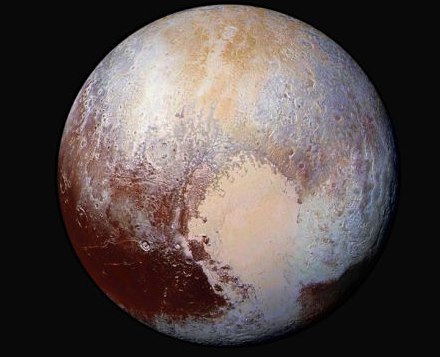
Pluto's surface -- seen from New Horizons

NASA's New Horizons probe successfully completed a flyby above dwarf planet Pluto in July, after a meandering 9-year, 3-billion-mile journey across our Solar System - - a first for humankind.   Before 2015 we only know Pluto from a blurry picture of the dwarf planet taken by the Hubble Space Telescope, but now we have a full topographical map in high resolution.  This is a huge step forward for science.

Pluto -- as seen by the Hubble Space Telescope (2010)
Pluto -- as seen from New Horizons (2015)

Why so difficult to see Pluto even with the huge, $2bn scope? Well first, it's really tiny.  To understand how small Pluto is, check out the illustration below of the Solar System objects drawn to scale (but not to distance).   The Sun is the big glowing yellow ball in the background, obviously.  Earth is the third ball at the bottom left, followed by the moon, Venus, and gas giants Jupiter, Saturn, Neptune, and Uranus.  Pluto is one the last 4 tiny dots on the right, along with some other Kuiper Belt Objects.


And Pluto is also far: its orbit is 30 times the distance from the Earth to the Sun.

Makes you think about how huge (and empty) the outer space is.   You see, New Horizons is speeding at ~40,000 mph away from the Sun, one of the fastest man-made objects in space.  Proxima Centauri, the closest star in our Milky Way galaxy, is 4 light years away.  If we send a spaceship going at the same (constant) speed as New Horizons, it would take 60,000 years to reach Proxima Centauri  (don't forget, thanks to the Sun's gravitational pull, the ship would continuously slow down unless it expends a lot of energy).  And that's just the closest star in our own galaxy.

So If you ever have doubts whether we'll ever find life beyond Earth, keep in mind that we've only scratched a tiny surface.

Proxima Centauri


Thursday, November 13, 2014

Congratulations ESA Rosetta-Philae


Congrats ESA Rosetta-Philae on the historic #cometlanding @ESA_Rosetta @philae2014.
Lots of science to get you where you are, and still lots more to come.
This is history being made and rewritten all over again...

I still don't know how the craft navigates; it's not like there's GPS signal in interplanetary space.  How does it know the distance to the comet (my guess: laser rangefinder?), how does telemetry work (ground telescope observation? Hubble?).  Somebody please enlighten me.

I also don't know if we could (theoretically) put a guy up there.  Would Bruce Willis and Ben Affleck puke their brains out going at 50,000 miles/hour chasing the comet?

I also wonder how they can take such detailed picture, with a 10 year old camera, in the dark of space, of an object going 40x the speed of sound.  I can't even take a good picture of kids playing soccer in bright daylight.  They must be using some special edition Go Pro or something...


Sunday, November 09, 2014

Thoughts on the Antares space probe explosion

I've wanted to write more about astrophysics, but as usual, real life has gotten in the way.  Well, last week the unmanned Antares space probe exploded upon liftoff.  Then the Virgin Galactic SpaceShipTwo crashed, killing its crew members.  These accidents were major setbacks and huge dismay, but it doesn't change my confidence that this and the coming decades will prove some very interesting developments in our understanding of our universe.

It's important to take a step back and see where we are in the age of space discovery.

The Voyager 1 and Voyager 2 space probes, launched in the 1970s, has successfully explored the outer planets Jupiter and Neptune.  Now both are exploring the interstellar space, more than 15 billion kilometers away from Earth.

The Cassini space probe visited Saturn's system, and its Huygens lander touched down at Titan in 2005, bringing us tons of data which will take years to analyze.  Yes, you heard that right.  We have taken terrestrial pictures from the surface of Titan, which is a moon of Saturn, which is a gas giant planet really far away. Don't forget this gorgeous picture of Earth (tiny dot on the lower right with the arrow) taken from Saturn.

View of Earth from Cassini, Saturn in foreground

In 2015 the New Horizons space probe will pass by dwarf planet Pluto, and subsequently enter the Kuiper belt at the outer edge of the Solar System for another 10 years before its nuclear power runs out.  The data we receive from the probe will lead us to discovery of countless findings, bringing our understanding of the universe to a more complete picture, while most likely raising many new questions altogether.

These are costly missions ultimately aimed at exploring the outer worlds.   I shudder to think what would happen if these missions never happened due to a launch explosion.....

Saturday, May 03, 2014

Will we find extra-terrestrial life?


Titan
Throughout history, humankind has looked up to the skies and wondered : "Is there anybody out there?"  Nevertheless, scientists -- outside of crop circle/UFO conspiracy theorists -- have never found definitive evidence confirming nor negating the possibility of life in space.  Sure, there is evidence of earth-like bodies such as Titan (one of Saturn's moons, complete with icy rock surfaces, oceans of liquid methane, and dense nitrogen atmosphere), Enceladus (another one of Saturn's moons, with likelihood of liquid water underneath its icy surface), and only discovered last month, Kepler 186f in another star system.

So these are possible places where we may solve the so-called "Fermi Paradox", but will actually we find evidence of life in any of these rocks?

Me, I believe that we will discover extra-terrestrial life in our lifetime. As a Muslim, we learn that the Koran states that God created life on earth and in the heavens, although some scholars have differing interpretations. I'm also a Battlestar Galactica fan, and although I don't believe we will be abandoning Earth for Caprica any time soon, but it's an interesting thought experiment nonetheless.

Opponents say there are just too many prerequisites for life; too many reasons why Earth is so perfect to enable complex life forms. The so-called "rare earth hypothesis" conjectures that in order for complex, multi cellular life to exist, there must be at least the following: a right-sized terrestrial planet (i.e. not a gaseous planet like Jupiter or Saturn) in the habitable "goldilocks" zone (i.e. not too hot and not too cold), a central star and planetary system, the advantage of a gas giant (i.e. Jupiter and Saturn's gravity protecting the Earth from stray asteroid impacts), large satellite, plate tectonics, the right atmosphere, and oceans. Not many, if any at all, planets have the advantage of all of these characteristics all at once.  Earth, they argue, is special because it ticks all of these boxes.

Sea cucumber

But in my opinion, here are some reasons why I am convinced that we will find evidence of extra-terrestrial life:

1. Looking at the signs on Earth, life has been discovered in the most extreme habitats. Bacteria lives in the upper atmosphere, where temperatures are beyond freezing, oxygen is lacking and UV radiation is plentiful. Sea cucumbers live 7 miles (!!!) deep in the Mariana Trench, where sunlight never touches and pressures are off the charts. Mountain stone insects can be frozen solid at -10C for months in the winter and come back to life come spring.  Hydrothermal vents in the deep sea are home to dense fauna feeding off hydrogen sulfide, a highly toxic chemical, and geothermal instead of sunlight as the primary energy source.  What we now assume as inhabitable zone at some planet out there, may actually turn out to be suitable homes to some yet-to-be-identified creatures.

Hydrothermal vents


2. Historically, life on Earth has survived five major extinction events, each of which eradicated >70% of all known species, and that's before mentioning "smaller" events like the Mt. Toba eruption that covered half of the Earth in plume and greenhouse gases. The tardigrade, for example, can withstand temperatures from just above 1 K (that's -450 F or -272 C, yes that is cold) up to well above 150 C, pressures 6x greater than those found in the deepest ocean trenches, radiations at hundreds of times higher than the lethal dose for a human, and the vacuum of outer space. It can go without food or water for 150 years, drying out to the point where they are 3% water, only to rehydrate, forage, and reproduce afterwards.  Who's to say that we won't find similarly-extreme survivalists at another star system in another galaxy?
Tardigrade


3. The pace of progress in human intelligence is exponential.  In only 10,000 years -- just a tiny part of the history of Earth -- humans have advanced from solely hunter-gatherers to observing space, actually setting foot on the moon, sending a probe to Saturn and even beyond the Solar System, and building a massive space telescope that can observe events happening at the beginning of time.  We did all of that.  If there's someone/-thing out there, it's only a matter of time before we find it.

4. It's just more fun that way. Saying that we are alone, or that our Earth is somehow so special, seems so self-centered and close-minded. Innovation are fostered when we believe things are possible. Can you imagine our world if the Wright Brothers gave up believing humans could fly like birds?

"I'll be back!" -- wait, different movie?

Will we be punching aliens ID4-style and screaming "hasta la vista baby" ? Probably not.

Even assuming that complex, multi-cellular, maybe intelligent life exists at other planets, consider this: the universe is 14 billion years old, and the Earth is much younger at 4.5 billion years old. Human civilization is around half a million years old, and this whole entire human history is only possible because we are experiencing a prolonged "warm" period in between ice ages. What are the chances that humanity's time, which will only last until the next glacial period or extinction event (another 50,000 years, scientists predict), will coincide with the story of another intelligent alien being? Probably slim. And that's only considering the time dimension.

What about the space? The universe, in case you haven't heard, is a pretty big place (and is continuously expanding too!). What are the chances that not only humans and aliens coincide in terms of time, but also get to meet IRL and hang out at Starbucks? Minuscule. What is possible is that we will find undisputed evidence, probably in the form of fossils, of simple life forms (some form of bacteria?) that lived half a billion years ago at some terrestrial body somewhere in space.

I do believe this will happen in our lifetime.